Hongdae nightlife starts building around nine in the evening and does not resolve into anything until well after the subway has stopped running. The only part of the night anybody can price for you in advance is the journey out of it, because everything else in the district moves around under you from one street to the next. Cover charges change with the night and the door and whoever is standing at it, and none of the guides quoting exact figures could show me where those figures came from. What follows is the part I could actually verify, plus the part I only understood after standing in it.
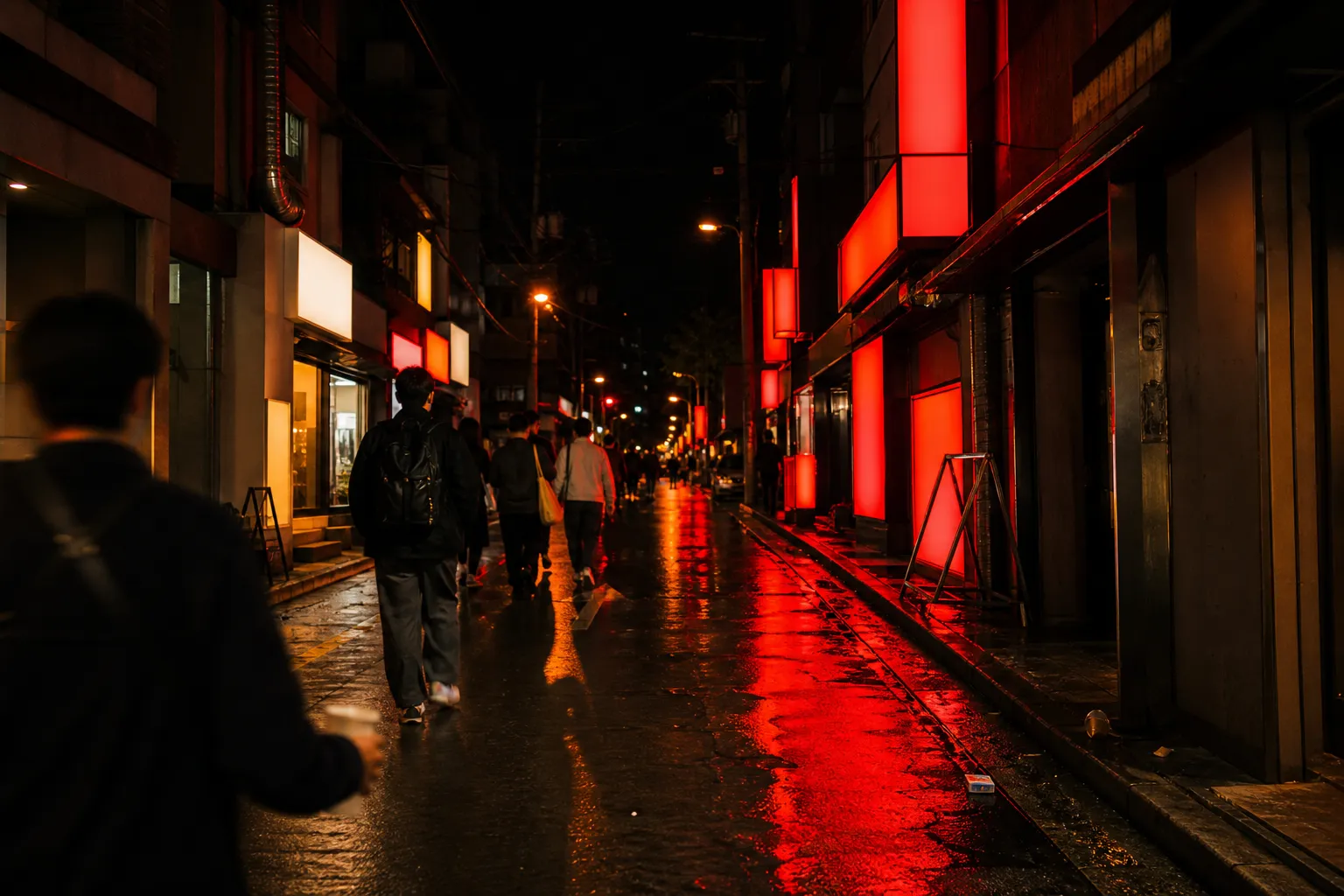
Hongdae Is A Student District That Never Learned To Close
Hongdae is the neighbourhood built around Hongik University, an art and design school in Mapo-gu, and every strange thing about the nightlife there follows from that one fact. The drinking is cheap because students have been drinking there for decades and the prices never fully caught up with the tourism. The buildings are small and stacked with signboards because the venues are small, which means the density is absurd and you can pass forty places in ten minutes of walking.
It also means the crowd skews young in a way that catches out anyone arriving from Gangnam or Itaewon expecting a similar room. The average age on the main strip on a Friday looked closer to twenty-two than thirty, and I noticed that before I noticed anything else about the place. That is not a complaint so much as a piece of information nobody puts near the top of a Hongdae article, and it changes who you should expect to be talking to.
The transport is the other reason the district works the way it does. Hongik University Station sits on Line 2, the Airport Railroad from Incheon, and the Gyeongui-Jungang Line, so people arrive from three directions and from the airport itself. A district that easy to reach fills up with people who did not plan to be there, and it empties in a hurry when the trains stop.
The Last Train Sets The Shape Of The Whole Night
Seoul’s subway runs from roughly half past five in the morning until around midnight, which the city’s own tourism service states plainly, and that single sentence organises everything that happens in Hongdae. The exact last departure varies by line and by direction and I did not stand on the platform with a stopwatch to confirm mine, so treat midnight as the shape of the thing rather than a promise.
What that produces is a night with a hinge in the middle of it. Before midnight the district is a bar district and leaving costs almost nothing. After midnight it becomes a club district and leaving costs real money, so a lot of people who intended to have one drink end up staying until five because the alternative was paying to go home at half past twelve. I watched that decision get made at several tables and I made it myself more than once, which is the closest thing to a trap the place actually sets.
Anyone who has read me on the door of a Japanese snack bar will recognise the structure. The money in these places is rarely in the thing you think you are buying, and it is usually in the thing you did not think about until you were already committed.
The Only Prices Anybody Can Quote You Are The Transport Ones
Seoul publishes its taxi fares, so those are the numbers I trust and the numbers worth planning around. A regular taxi in Seoul starts at 4,800 won, which is about $3.56 at the rate I checked on the day of writing, 1,346.56 won to the dollar. The meter also charges an idle rate of 100 won for every thirty seconds you spend not moving, and Hongdae after two in the morning is a place where a car spends a lot of time not moving.
The late-night surcharge is the part that quietly doubles a night’s exit cost. Between ten and eleven at night, and again between two and four in the morning, the distance rate runs at 120 won per 131 metres, and between eleven and two it climbs to 140 won per 131 metres. So the most expensive hour to leave Hongdae is the exact hour most people decide to leave it. Deluxe taxis have a higher starting fare but carry no late-night surcharge at all, which makes them the better choice at precisely the moment nobody is doing arithmetic.
The late-night bus is the option almost no visitor uses and the one I ended up relying on, at 2,500 won for an adult fare, or about $1.86. It is slower and it is not romantic and it will not take you door to door, but it costs less than a fifth of what a car costs at that hour.
I am deliberately not giving you a cover charge. Several pages ranking for this district quote entry fees down to the won, and when I went looking for a venue that published those numbers itself I could not find one, so repeating them would just be laundering somebody else’s guess into a second source.
The Door Is The Part Nobody Writes Down
The doors in Hongdae are discretionary and they are not obliged to tell you anything, which is the single biggest gap between the guides and the experience. Some nights a queue moves and some nights it does not move for you specifically, and the reason is never stated out loud because stating it would be a problem for the venue. I was turned away once with a flat hand and no sentence attached, and I was waved past a queue of thirty people twenty minutes later at a place two streets over.
Carry your passport, because Korea enforces a minimum drinking age and a foreign face invites the check far more often than a local one does. A driving licence from your own country is not reliably going to satisfy anybody at that step. Beyond that the rules are whatever the door decides, and arguing with it is the fastest way to guarantee the answer stays no.
This is a different economy from a Japanese hostess club, where the money buys you a seat and the seat comes with a person whose job is to talk to you. In Hongdae you pay to be let into a room and then you are entirely on your own inside it, which is a much worse deal than it sounds when you are standing outside and the entry fee feels like the whole obstacle.
Nobody Talks Inside, And That Is The Design
The clubs in Hongdae are loud enough that conversation is functionally impossible, and I stopped treating that as a flaw once I accepted it was deliberate. A room where nobody can hear anybody is a room where the whole interaction happens through proximity and body language and buying a drink, which suits some people enormously and suited me not at all. Two hours of shouting into someone’s ear produced less than ten minutes at a pojangmacha tent outside afterwards.
So the honest sequence, for me, ran backwards from what the guides describe. The club was where the evening went to die, and the useful part was the street food tents and the convenience store steps and the walk between venues, where people were audible and nobody had paid to be anywhere. If you are going to Hongdae hoping to meet somebody rather than hoping to dance, the outside is worth more than the inside and it costs nothing.
The Apps Do The Work The Street Pretends To Do
Almost every conversation I had in Seoul that went anywhere had started on a phone before it reached a bar, and Hongdae did not change that. The district is very good at putting a large number of people in a small space and very bad at giving any two of them a reason to speak. That gap is exactly what the apps fill, and the local ones fill it better than the international ones do.
The complication is that most of them will not let a visitor in. I went through what the Korean apps actually charge and what they demand after finally getting past their registration walls, and the short version is that a Korean phone number registered in your own name is the real gate. That leaves Tinder carrying most of the foreigner traffic in Seoul by default rather than by merit, which shapes who you find on it in a way that took me a while to see clearly.
What time should I get to Hongdae?
Arrive around nine or ten if you want the bars, and closer to midnight if you only care about the clubs. Getting there at eight means watching the district assemble itself around you, which is pleasant and completely empty of anybody to talk to.
Is Hongdae better than Itaewon for a foreigner?
Hongdae is younger, cheaper and more Korean, and Itaewon is more international and more comfortable if you speak no Korean at all. I preferred Hongdae for the street and Itaewon for the actual conversations, so the honest answer is that they solve different halves of the same problem.
What happens if I miss the last train?
You take a taxi at the surcharge rate, or you take the late-night bus at 2,500 won, or you stay out until the subway restarts in the morning. Plenty of people choose the third option and the district is built to absorb them.
Will I actually meet somebody in a Hongdae club?
Possibly, but the club is the worst room in the district for it, because nobody can hear you. Everything I saw work happened in the queue, on the street, at a food tent, or on a phone hours earlier.
The number worth writing on your hand before you go out is not the cover charge, because you cannot know it in advance and it will not be the largest line in the evening anyway. It is the hour the trains stop, because that is the moment the district quietly changes what it charges you for standing in it.