Susukino is Sapporo’s entertainment district, a rectangle of roughly a dozen city blocks sitting three subway minutes south of the main station, and it holds more bars, izakaya and red-light business than anywhere else in Japan north of Tokyo. The tourist pages describe the neon and then stop. What none of them mention is that the men who approach you on its corners are committing an offence under a city ordinance that has been enforced since 2005, and I only learnt that after I had already followed one of them into a lift.
Susukino Is Smaller Than Its Neon Suggests
The whole district runs from Minami 4 to Minami 6 north to south and from Nishi 2 chome to Nishi 6 chome east to west, which is a rectangle I can cross on foot in about twelve minutes without hurrying. The Susukino Tourist Association draws those boundaries itself, and they matter more than they sound, because almost everything in this city that costs money after dark happens inside them. The centre of it is the crossing at Minami 4 between Nishi 3 and Nishi 4 chome, under the Nikka whisky sign that has hung on the Susukino Building for decades with its painted blender’s face and its colour-shifting background. Everybody photographs that corner, and I have stood there in February watching a queue form to photograph an ice sculpture on the same pavement, because the district doubles as one of the Snow Festival sites.
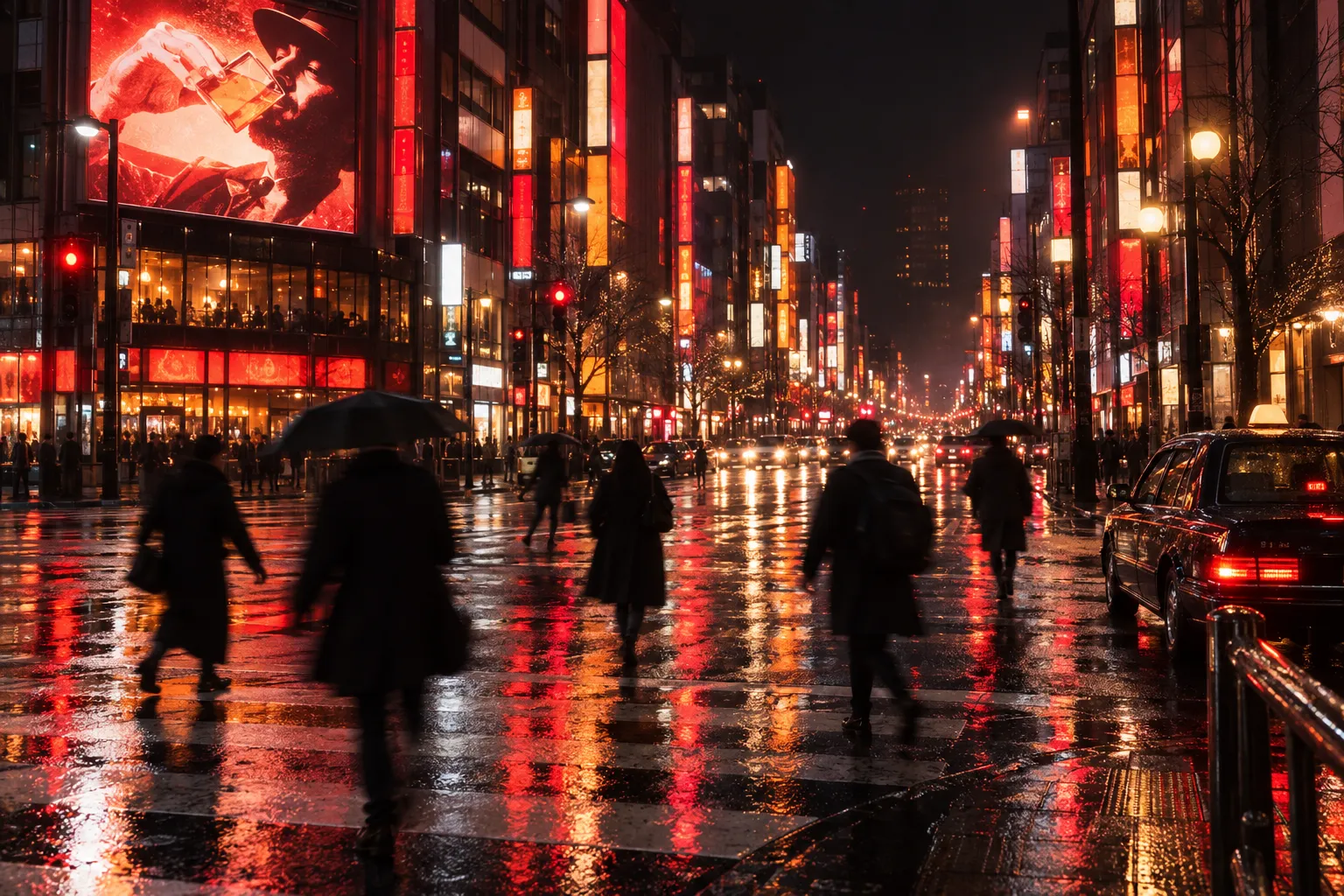
Getting there costs almost nothing, which is the first honest number in the district. Susukino Station sits one stop from Odori on the Nanboku subway line, about a minute of travel for 210 yen ($1.34), and two stops from Sapporo Station, roughly three minutes for the same fare. Japan Guide, which calls it the largest entertainment quarter in Japan north of Tokyo, publishes those fares on its own page and they were still current when I checked this morning. After that fare, nothing else in Susukino is priced anywhere you can read it from the street.
The Men on the Corner Are Breaking a City Ordinance
Street touting in Susukino is illegal under a Sapporo city ordinance that everybody simply calls the Susukino Ordinance, and it took effect on the first of December 2005. The original version banned soliciting people to work in adult venues, banned calling out or handing over flyers to pull customers into sex businesses, and banned sexually explicit advertising visible from the street or from a public indoor space. An amendment that came into force on the twenty-third of June 2016 widened the prohibited solicitation to cover specified entertainment drinking establishments as well, which in practice means the ordinary bar touts and not only the red-light ones. The prohibited zone is drawn by four city roads and Route 5 along the Sosei River, and it wraps the district almost exactly.
The penalties on paper are not decorative in the slightest. An individual caught soliciting inside that zone faces a fine of up to 500,000 yen ($3,186), or detention, or a minor fine, with heavier treatment for anyone doing it habitually. A person who puts others up to the work can be fined up to 1,000,000 yen ($6,373), and a company carries liability when its employees do it during business hours. You would never guess any of that from twenty minutes on the pavement at eleven at night, because the men work in the open, under the lights, spaced comfortably apart.
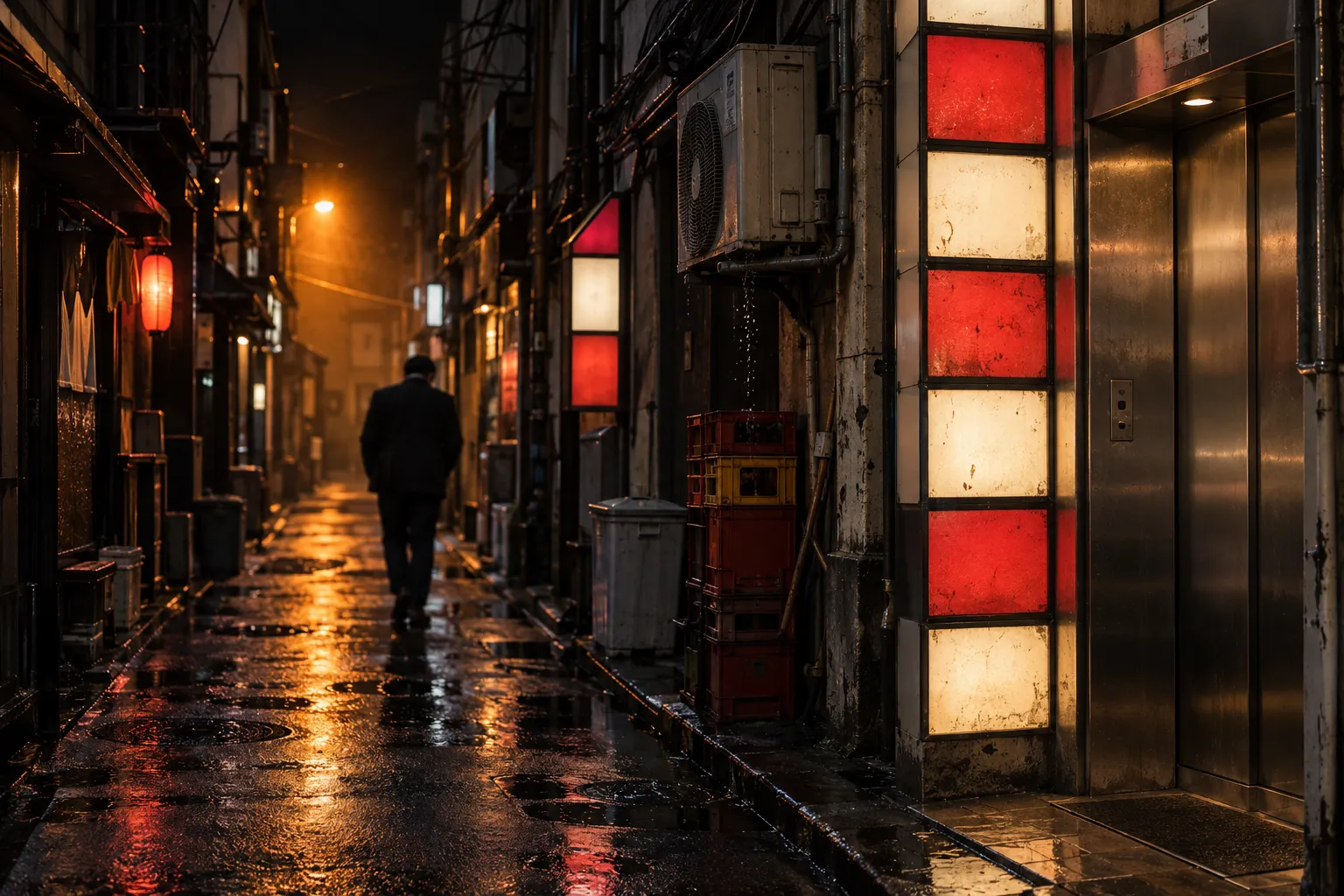
I get approached more often than the Japanese men walking a metre ahead of me, and I have stopped reading that as an insult, because it’s arithmetic rather than anything personal. A foreigner can’t read the sign plates, won’t quote an ordinance number back at anybody, and isn’t going to be standing on that corner again next Friday in front of regulars. That makes me worth more per approach than a local does, which is why the pitch is warm and the walk to the lift is always brisk.
The Bill Goes Wrong Before I Sit Down
Almost nothing that costs me money in Susukino involves a fake number, and that is precisely why it works on people who consider themselves careful. It involves a real number that quietly covers less than I assumed it covered. The Japanese word for the result is bottakuri, which translates roughly as being fleeced, and its usual shape is a quoted drink price sitting underneath a seat charge, a small dish nobody ordered, a weekend surcharge and a service percentage calculated on the whole stack. Every one of those additions has an ordinary name and exists perfectly legitimately elsewhere in the country. Anybody who has settled a set charge in a kyabakura or a bottle-keep tab in a snack bar recognises that grammar on sight, because those places charge in the same order and simply tell you first.
What changes in a rip-off house is the sequence of events. The terms surface after I’m seated, in a room I would have to leave past the man who walked me in, and that sequence is the entire product being sold. Kabukicho in Tokyo runs the same mechanism at a larger scale, and almost every warning written about it transfers to Susukino word for word. The difference between the two is size rather than method, and a smaller district means the same handful of corners keeps producing the same handful of approaches all night.
The venues that price honestly are easy to find and nobody writes about them, which skews the whole picture. Golden Gai in Shinjuku works because most of its doors carry the seat charge in paint before you touch the handle, and Susukino has plenty of bars doing exactly that. I ask for the seat charge and the time block out loud before my coat comes off, and a venue that answers both with figures is almost never the venue that ruins an evening.
Some Doors Here Are Still Closed to Me
A fair number of the small counter bars in Susukino won’t take me, and the refusal is usually polite and completely final. The mama running a six-seat room is protecting a regular crowd and a conversation she can actually hold, and a foreigner without Japanese breaks both of those at once. I’ve been turned away at the door with an apology and a hand gesture, and I’ve also been waved inside by the same kind of place two streets over because somebody in there felt like it that night. No rule I can learn reliably predicts which of the two happens.
That arbitrariness isn’t hostility, and reading it as hostility is what turns an ordinary evening sour. The rooms that always let me in are the bigger, brighter, more commercial ones, which are also the rooms where the bill is most likely to be assembled out of charges I never saw coming. The friendliest door in Susukino and the most expensive door in Susukino are frequently the same door, and that correlation has cost me a great deal more than any language barrier ever has.
The Ramen Alleys Are the One Thing Everyone Gets Right
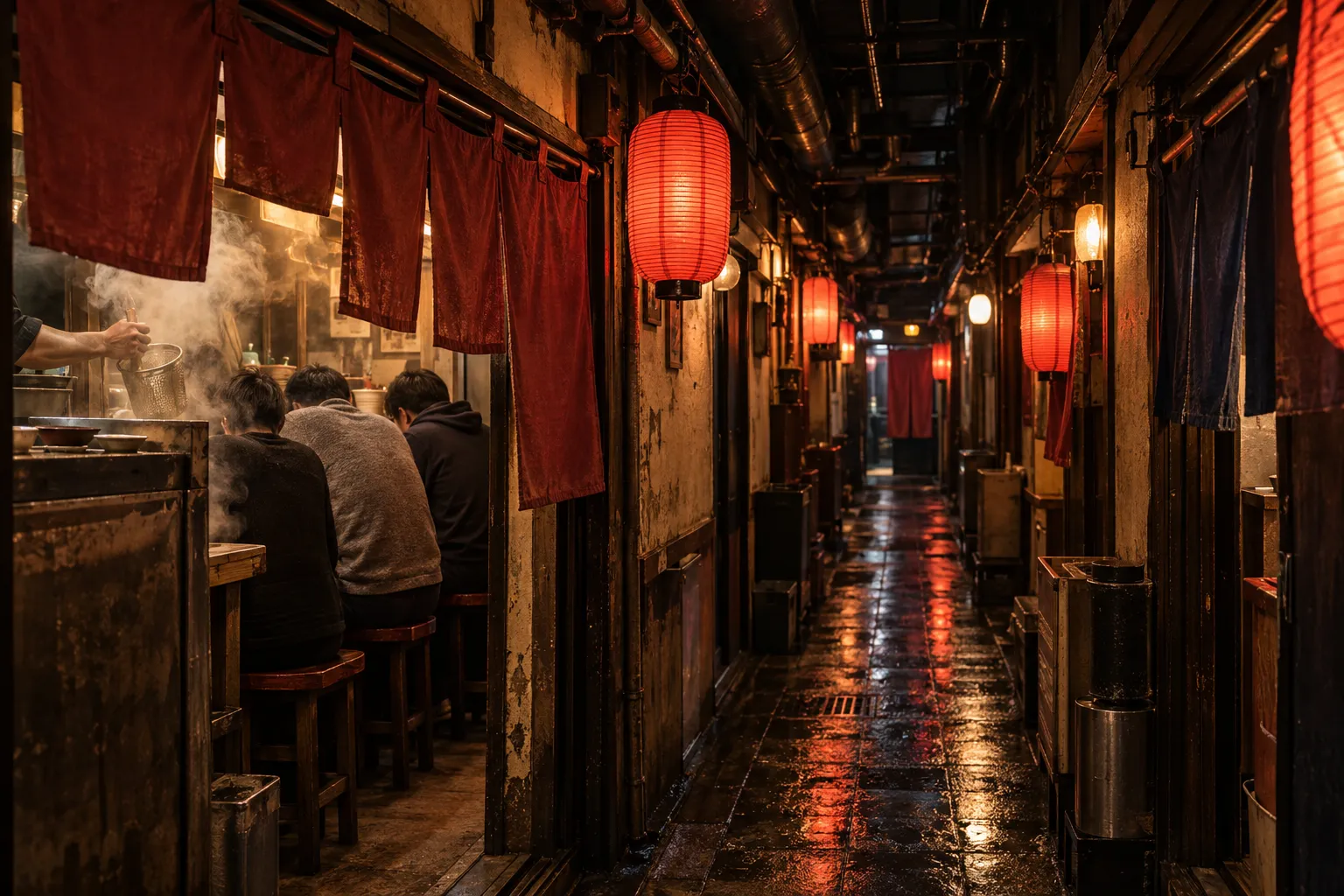
Susukino has two ramen alleys, Ganso Ramen Yokocho and Shin Ramen Yokocho, and they’re the single part of the district where the tourist pages and my own experience agree completely. Both are narrow covered lanes of tiny counters, most of them seating eight or nine people, and the prices hang on the wall in front of your face before you sit down. Nobody stands outside trying to walk you in, nobody adds a seat charge afterwards, and the whole transaction is finished inside twenty minutes.
The local ending to a night here isn’t ramen though, or at least not only ramen. Sapporo people finish drinking with a parfait instead, which the city’s own tourism office points out with some pride. There’s also a Ferris wheel on the roof of one of the buildings, lit up above the signage, which sounds like something I invented and isn’t. I rode it sober and looked down at the grid of red and amber I’d been walking through for three days, and the entire district looked about the size of a car park.
What an Ordinary Night in Susukino Costs Me
Susukino costs me whatever I agreed to before sitting down, and every bad night I’ve had here began with agreeing to something out on the pavement. The place isn’t dangerous in the way a nervous first visit imagines it will be. I’ve walked it at every hour including the dead stretch after the last subway, and the only thing that has ever actually gone wrong was financial.
Set against Tobita Shinchi in Osaka, where the prices are posted, fixed and identical from one house to the next, Susukino is organised around ambiguity and earns its margin from it. That isn’t a moral judgement on either place, just a description of how two markets happen to be arranged. Tobita tells you the number and Susukino makes you ask for it, and the ordinance sitting in the Sapporo city archive exists because enough people never asked.
Is Susukino safe to walk at night?
Physically it has been, at every hour I’ve tried it, and I’ve never felt at risk from another person there. The danger in Susukino is financial rather than violent, and it concentrates entirely in the few seconds on the pavement when a stranger quotes a number and you decide whether to believe him.
Is it illegal for touts to approach me in Susukino?
Yes, inside the designated zone it is. The Susukino Ordinance has banned soliciting since December 2005 and was widened in June 2016 to cover ordinary drinking establishments, with fines reaching 500,000 yen ($3,186) for an individual and 1,000,000 yen ($6,373) for whoever put him out there.
How do I get to Susukino from Sapporo Station?
Take the Nanboku subway line two stops south, which runs about three minutes and costs 210 yen ($1.34). Susukino Station empties straight onto the main crossing, so there’s no walking left to do once you’ve come up the stairs.
Do bars in Susukino refuse foreigners?
Some of the small counter bars do, and they’re generally polite about it. The bigger and more commercial the room, the more likely I am to be welcomed at the door and the more likely the final bill is to carry charges nobody mentioned on the way in.
Susukino is the rare district where the law is entirely on my side and completely useless to me in the moment it matters, because no fine written into a city ordinance has ever reached me at one in the morning with a friendly man already three steps ahead and talking.